What is TOG in baby sleeping bags, and how do you choose the right one?
TOG is a number that tells you how warm a fabric is: the higher the TOG, the warmer the baby sleeping bag. As soon as you start looking at sleeping bags, you will see it everywhere. It can look like a mysterious code, but it is simply a guide to how warm a garment is and which room temperature it is made for.
In this guide we explain what TOG means, how it works and how to choose the right TOG for your baby, with practical examples of room temperatures and layers. For specific questions about health or sleep, always check with your paediatrician or health visitor.
What is TOG and what is it used for in baby clothing?
What does TOG stand for?
TOG stands for Thermal Overall Grade. It is a unit used to measure the thermal resistance of a fabric, in other words how much heat it can hold in.
The higher the TOG, the warmer the garment. The lower the TOG, the lighter and cooler it feels.
The textile industry uses it to check whether a garment is warm enough for certain conditions. You may already know it from duvets: baby sleeping bags use the same scale.
How is TOG measured, and what does it tell you about warmth?
The TOG value is measured in a laboratory, by looking at:
- How much warm air the fabric holds in.
- How the garment behaves next to a heat source.
The result is a number (0.4, 0.5, 1.0, 2.5…) that tells you:
- Whether it suits warm, mild or cold temperatures.
- Whether your baby needs more or fewer layers underneath.
You don't need to know the technical details of the test. What matters is that TOG is a warmth indicator: it helps you match the sleeping bag, or the sleeping bag with legs, to the temperature of your baby's room.
How does TOG work in a baby sleeping bag?
TOG and room temperature
For babies, TOG is used mainly for:
- Baby sleeping bags (also called sleep sacks).
- Sleeping bags with legs and other closed sleepwear.
The idea is simple:
- Cooler room → higher TOG.
- Warmer room → lower TOG.
That is why a room thermometer in the nursery is so useful.
High TOG vs low TOG: when to use each one
As a rule of thumb:
Low TOG (0.5)
- Very light fabric.
- For warm rooms and summer nights.
Medium TOG (1.0)
- In-between warmth.
- For mild temperatures, typical of spring and autumn.
High TOG (2.5)
- More insulation.
- For cooler rooms in autumn and winter.
From there, you adjust the layers your baby wears under the sleeping bag depending on how they feel.
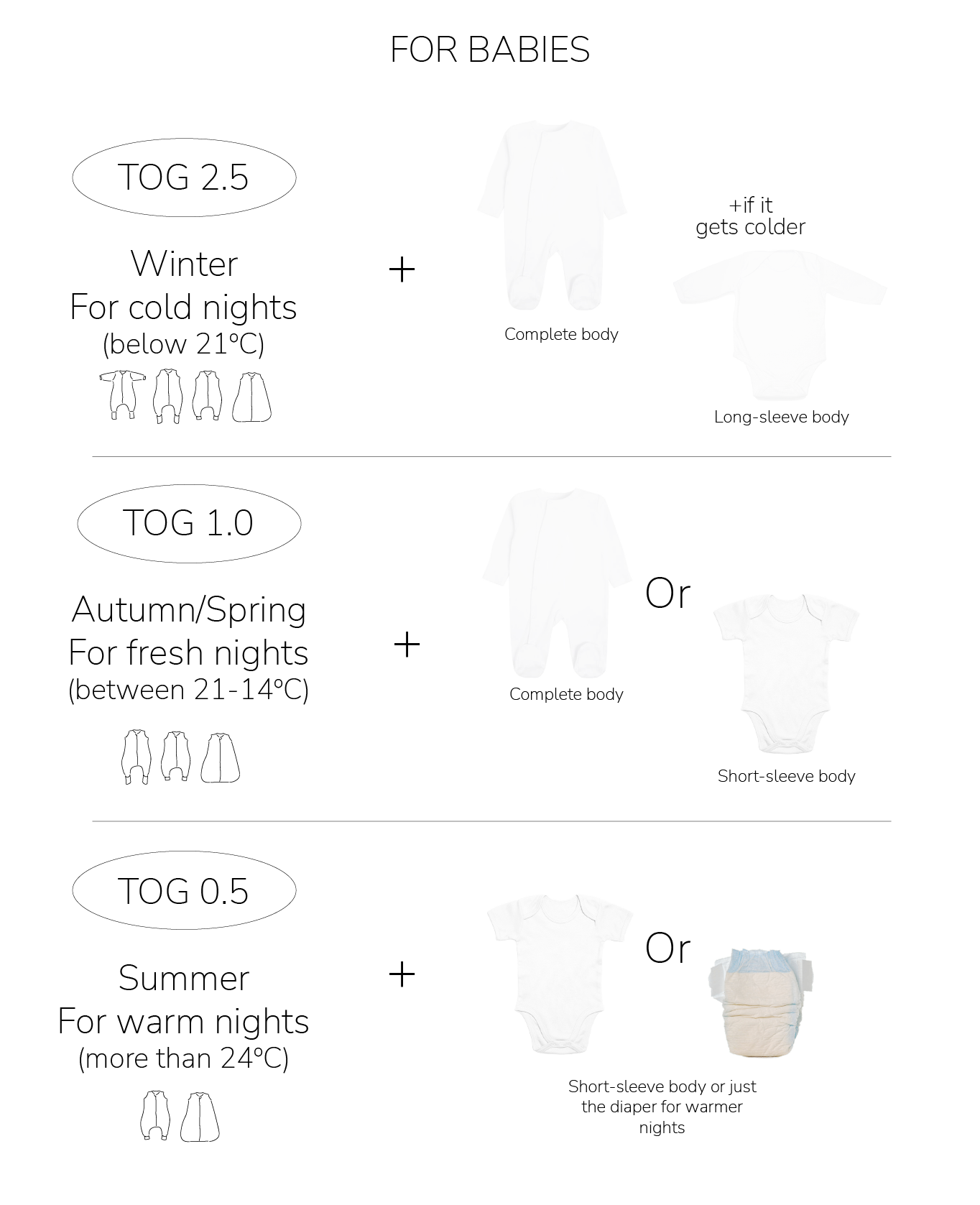
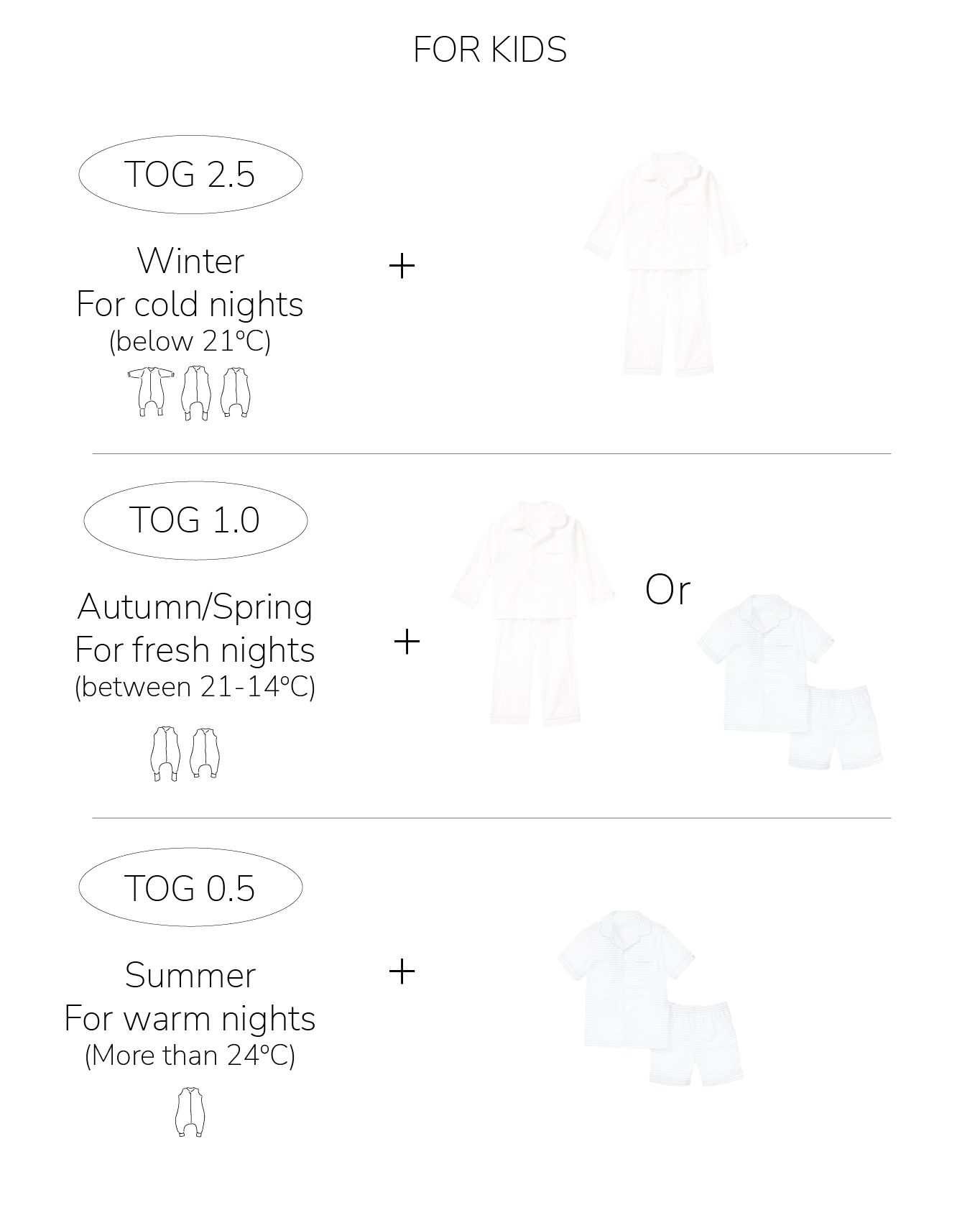
TOG chart: which TOG for which room temperature?
At molis&co we design our sleeping bags and sleeping bags with legs in the TOGs that best suit each season and room temperature. Our size and TOG guide will help you choose the right one for your baby.
Quick guide
- 23–27 °C → TOG 0.5 · short-sleeved bodysuit, or just a nappy on very hot nights.
- 21–23 °C → TOG 1.0 · short-sleeved bodysuit + thin cotton sleepsuit.
- Below 21 °C → TOG 2.5 · long-sleeved bodysuit + warm sleepsuit.
TOG 0.4–0.5: summer and warm rooms (23–27 °C)
- Made for hot nights.
- Ideal for rooms of around 23–27 °C.
- Thin, very breathable, lightweight fabrics.
Examples:
- Baby in a sleeveless or short-sleeved bodysuit + TOG 0.5 summer sleeping bag.
- When it is very hot, some babies only need a bodysuit, or even just a nappy (always following your paediatrician's advice).
TOG 1.0: spring and autumn (21–23 °C)
- For mild room temperatures.
- Recommended in spring and autumn, or in homes that stay at that temperature most of the year.
Examples:
- Short-sleeved bodysuit + thin cotton sleepsuit + TOG 1.0 sleeping bag.
- If your baby runs warm, a bodysuit + TOG 1.0 sleeping bag may be enough.
TOG 2.5: winter and cooler rooms (below 21 °C)
- Made for cooler rooms.
- For rooms below 21 °C.
Examples:
- Long-sleeved bodysuit + warm sleepsuit + TOG 2.5 sleeping bag.
- If the room is a little warmer or your baby runs hot, take off one layer (for example, skip the bodysuit).
It is always better to adjust one layer than to overdress. If in doubt, feel the back of your baby's neck and chest.
What should your baby wear under the sleeping bag?
Bodysuit, sleepsuit and layers
Under the sleeping bag you can use:
- A short- or long-sleeved bodysuit (vest).
- A sleepsuit.
- Both, if it is colder.
A few ideas:
- If the room is at the warm end of the range for that TOG, use fewer layers underneath.
- If it is at the cool end, you can add a layer, always checking that your baby isn't sweating or getting too hot.
Our advice is simple: dress them as you would dress yourself, or even a little lighter, especially if the room is small or holds the heat.
Examples by temperature and type of cot
Inside the cot, the space can hold a little of the heat your baby gives off, so it can feel slightly warmer than the rest of the room, especially in spring and summer.
Examples:
Room at 24–25 °C, TOG 0.5
- Short-sleeved bodysuit.
- Lightweight TOG 0.5 sleeping bag.
Room at 21–22 °C, TOG 1.0
- Short-sleeved bodysuit.
- Thin one-piece sleepsuit.
- TOG 1.0 sleeping bag.
Room at 18–20 °C, TOG 2.5
- Long-sleeved bodysuit.
- Sleepsuit.
- TOG 2.5 sleeping bag.
These are general examples: every baby is different, and so is every home. Always adjust by watching your baby.
How to tell if your baby is too hot or too cold in a sleeping bag
The chest and neck test: what you should feel
Hands and feet are usually cooler, so it is better to check the back of the neck and the chest.
What you should feel:
- Warm and dry → well dressed.
- Very hot or sweaty → probably overdressed, or the TOG is too high.
- Cold to the touch → may need one more layer or a higher TOG.
Signs the TOG isn't right
As well as touch, look out for:
- Lots of sweating, damp hair or damp clothes.
- Fast breathing or clear discomfort.
- Restlessness, waking often and feeling very hot.
- Cold skin, looking curled up.
If so, try:
- A lower TOG or one layer less if your baby is hot.
- A higher TOG or one light extra layer if your baby is cold.
We have an article on how to tell if your baby is too hot or too cold while sleeping. If you still have questions, or notice any symptom that worries you, always check with your paediatrician.
Does your baby need a blanket if they're already in a sleeping bag?
Sleeping bags and blankets: what we recommend
With a sleeping bag, your baby doesn't need loose blankets. The sleeping bag itself is designed to:
- Keep a steady temperature.
- Stop your baby kicking off the covers during the night.
Even so, you can use a light blanket, thin quilt or sheet for a different reason: so that, little by little, your child learns to cover themselves, especially as they get older.
If you do use a blanket, keep it light and tucked in firmly at the sides of the cot, and always check on your baby.
How to help them learn to cover themselves
As your child grows, you can:
- Offer the same blanket at every bedtime.
- Encourage them to pull it over themselves as part of the routine.
- Let them experiment, knowing the sleeping bag already keeps them warm.
That way the sleeping bag remains the key piece for their comfort, and the blanket becomes an extra they can manage when they are ready.
How to choose the right TOG for your baby, step by step
To make it easier, follow these steps:
- Check the room temperature with a room thermometer.
- Choose the TOG for that temperature (0.5, 1.0 or 2.5).
- Decide on the layers under the sleeping bag: bodysuit, sleepsuit or both.
- Feel the neck and chest after a while.
- Adjust the TOG or the layers if your baby feels too cold or too hot.
Over time you will get to know how your baby reacts to cold and heat, and choosing the right sleeping bag for each night will become much easier. For sizes, see our size and TOG guide
For specific questions about health or sleep, remember: your paediatrician is always the best person to ask.